FREDERICK KRAUSENECK MOVES TO AMERICA, BLUMFIELD COUNTY, MI
by Vern Bender | Sep 9, 2026 | ABRAHAM, AMERICA, Anastasia vonDerau, BENDER., BLM, BOHEMIA, C S LEWIS, CESIGNER, CHRISTIANITY, CIA, COMMUNISM, consciousness, CS LEWIS, Designer & Creator, DESTROY GLOBALISM, EXISTENCE EXPLAINED, FIXING CHRISTIANITY, GERMANY., GERMANY., GOD, HAMAS, HESBOLAH, human brain, ISRAEL, ISREAL, JRR TOLKIEN, KING DAVID, KRAUSNECK, KRUSENECK, KRUSENECK, KRUSENECK, KRUSENECK, MARX, QUANTUM ENTANGLEMENT, Science & Christianity, SCIENCE VALIDATES GOD, SIR ROGER PENROSE, SOCIALISM, STALIN, TERRORISTS, The World Economic Forum, Uncategorized, Vern's Blog, VON KRAUSENECK, www.vernbender.com, www.vernbender.com |

Krauseneck Family
- The oldest known member of the family
von Krauseneck ist Johannes von
Krauseneck, a general in the
Bohemian army in the year 1400.
Additional details are not known. His
descendants had moved at the time of
the Lutheran Reformation, some to
Bohemia and some to Franconia. Those moving to
Franconia left the Catholic faith and joined the
Evangelical Confession. Some of them became Lutheran
pastors.
In 1854, Frederick William, Gustave Carl, and Betty
Krauseneck and her husband, Anton Schmitz, came to
Blumfield Township (north of Frankenmuth). They were
the children of Friederich Wilhelm Krauseneck (1797-
1881) and his wife, Maria née Benoit (1798-1860).
Frederick William Krauseneck was born in 1819. In
1861, having lived in Blumfield Township for seven
Years later, he volunteered to fight in the Civil War. He was
wounded in battle and died in Washington, D.C.
Hospital in 1864. Records indicate he had no children.
Frederick’s younger brother, Gustave Carl, born in
Koblenz, Prussia in 1836, farmed in Blumfield
Township. He married Matilda Olde, whose parents
owned a department store in Mt. Clemens.
The couple had nine children:
Frederick William (1863-1940) lived in Mount Clemens.
Michigan and had four children.
Charles Albert (1865-1950) lived in Saginaw, Michigan, and had three daughters.
Henry Gustave (1867-1937) lived in Bloomfield.
Township, Michigan, and had eight children.
Bertha Amanda (1869-1939) married George Jenny.
Lived in Lansing, Michigan, and had no children.
Alma Mathilda (1872-1940) married Edward Hodges.
Lived in Saginaw, Michigan, and had two children.
Arthur Ernest (1874-1946) lived in Minnesota and had
no children.
Otto Herman (1876-1956) lived in Mount Clemens.
Michigan and never married.
Lora Maria (1879-1956) married Charles Chambers.
lived in Detroit, Michigan, and had one son.
Meta Emma (1882-1961) lived in Detroit, Michigan, and
never married.
Gustave loved to tell his grandchildren about the many
animals and the friendly Indians he would meet as he
walked through the forest to visit his brother and sister.
While delivering a barrel
- of salt pork, he met some hungry wolves on one cold winter day. To keep the
wolves away from his horses; he had to open the barrel
and throw them a piece of salt pork now and then.
Like his father, Gustave wrote many poems about his
family, the wilderness, and its animals. He had a
collection of flutes that he played, and he frequently
entertained his grandchildren with singing and the
teaching of songs.
1906, after Gustave retired, his son Henry took over
the family farm. Henry and his brother Otto played
coronets in the Arthur Community Band. Henry also
played the violin. Henry had a small blacksmith shop on
his farm and did odd jobs for his neighbors. He was
Secretary-Treasurer of the Arthur Thrashing Company
for several years. He also served on the Arthur
School District Board as long as his children attended the
Arthur School. After Henry died in 1937, his son.
Lawrence owned the Krauseneck farm.
Betty Krauseneck Schmitz came to America with her
husband, Anton, and lived in Blumfield Township. They
had three children. Anton Schmitz was very influential.
in developing the Germania Society in Saginaw,
- donating 1000 books to the Society’s library and
leaving an endowment to the organization.
Researched & Compiled by Bavarian Inn Lodge
For copies of family histories, go to www.bavarianinn.com/familyhistory.
- Johann Christoph Krauseneck (died 1799), German composer and poet.
- DataSurnameKrauseneckForenameJohann ChristophGND104221887(DNB)Area of activityArt
KRAUSENECK (Johann Christoph): Chamber Secretary at Baireuth; born on June 16, 1738 to Zell im Baireuthischen, where his father evangelized. He was a preacher. In 1753 he came to the Gymnasium in Bayreuth and, in 1756, to the University of Erlangen to study theology but afterward left this study due to a predominant inclination towards poetry and became a tutor to the Baireuthischer Oberjägermeister von Schirnding, who at the same time needed him as a secretary in forestry matters. In 1783, he became chamber registrar in Baireuth, and in 1792, real chamber secretary. He had thorough erudition in the writings of the old and new, firm principles in criticism, and a very educated, fine taste; and he was a very popular poet in his time. His odes, idylls, and sacred songs, for which he usually wrote the melodies himself as an excellent pianist and good composer, met with great approval. He died on June 7, 1799. Writings:
Cf. Meyer’s biographer. News from Ansbach and Bayreuth. Writer, p. 179. Liederdichter Th. I. S. 278–280. Bayreuth B. V. S. 128–134. Lexikon alter u. neuer geistlicher Liederdichter S. 178. Deutschland 5. A. B. IV. P. 260. B. X. P. 141. and B. XI. P. 459. Writings. B. VII. P. 334. Baurs Handwörterbuch B. III. P. 126. 1800. n. 74. p. 734. Rotermunds Lexikon B. III. P. 833. Jördens Lexikon teutscher Dichter und Prosaisten B. VI. S. 439–443. Lipowsky: Bayerisches Musik-Lexikon 1811. p. 157. Ladvocat’s Handwörterbuch B. IX. P. 586.
- 1. The Casual, a comic heroic poem. 8. Bayreuth, 1765 and 1767.
- 2. Fatime, or the Tribute Girl, a spectacle. Eb. 1770.
- . Zama, the young Moroccan IMG_3175 FeloniousMunk woman, a spectacle. Eb. 1770.
- 4. The Gold Makers, comedy in a plot. Eb. 1772.
- 5. Songs, in Ch. H. Schmidt’s Anthologie der Teutschen, 1772.
- 6. Jn. Georg Eman. Roßner’s collection of some poems. 8. Baireuth 1773.
- 7. Poems and idylls; in the Almanac of the German Muses. Leipz. 1773, 1777, and 1781.
- 8. Poems: in paperback for poets and poet friends. Leipzig, 1774–1780.
- 9. The advertisement for England, comedy in an elevator. 8. Bayreuth, 1776.
- 10. Poems. First collection. February 8, 1776. Second collection. E b. 1783.
- 11. The Prince’s Journey, rural comedy in an elevator. Eb. 1777.
- 12. Field song of a German grenadier in North America. Eb. 1778.
- 13. Contest in front of and in Gibraltar. Eb. 1782.
- 14. Poems, in J. H. M. Ernesti’s Practical Handbook of Eloquence and Poetry. Nürnb. 1784.
- 15. Poems; in the Franconian Almanac of the Muses by Joh. Friedr. Degen. Nürnb. 1787.
- 16. Poems in the Teutschen Museum.
- 17. Burgrave Albrecht the Fair and Karintha von Orlamünde, a dialogue story from the fourteenth century, in the Franconian archives of Büttner, Keerl, and Fischer. And b. 1790. B. I. n. 1.
- 18. Idyll: the happy recovery of the president of the Chamber of Flotow. Fol. Baireuth 1790.
- 19. Albrecht Achilles, Margrave of Brandenburg: a patriotic spectacle in 5 acts. 8 Feb. 1790.
- 20. The rural Feyer of the Prince’s Day, a village painting in a plot. Eb. 1791.
- 21. Folk song. Eb. 1792.
- 22. Poem dedicated to Mr. Director Uz, in the Ansbacher Monathsschrift B. 2. Heft 5. S. 454.
- 23. Prosaic and poetic leprosies in the new collector. Acquire.
- 24. Many individually printed odes and songs, with and without melodies.
Footnotes
- ↑ See General Teutsche Bibl. B. 31. II. p. 497.
- ↑ s. Gotth. gel. Z. 1776. St. 47. S. 377.
- ↑ See Teutscher Merkur, 1777, Sept., p. 286.
- ↑ See Obert. Lit. Z. 1790. I. p. 670. Allg. teutsche Bibl. B. 111. I. S.
- DataSurnameKrauseneckForenameJohann ChristophGND104221887( DNB )Area of activityArt
KRAUSENECK (Johann Christoph): Chamber secretary at Bayreuth; born on June 16, 1738, in Zell im Baireuthischen, where his father evangelized. He was a preacher. In 1753 he came to the Gymnasium in Bayreuth and, in 1756, to the University of Erlangen to study theology but afterward left this study due to a predominant inclination towards poetry and became a tutor to the Bayreuthischer Oberjägermeister von Schirnding, who at the same time needed him as a secretary in forestry matters. In 1783, he became chamber registrar in Bayreuth, and in 1792, real chamber secretary. He had thorough erudition in the writings of the old and new, firm principles in criticism, a very educated and fine taste, and was a very popular poet in his time. His odes, idylls, and sacred songs, for which he usually wrote the melodies himself as an excellent pianist and good composer, met with great approval. He died on June 7, 1799. Writings:
Cf. Meyer’s biographer. News from Ansbach and Bayreuth. Writer p. 179. Liederdichter Th. I. S. 278–280. Bayreuth B. V. S. 128–134. Lexikon alter u. neue geistliche Liederdichter S. 178. Deutschland 5. A. B. IV. P. 260. B. X. P. 141. and B. XI. P. 459. Writings. B. VII. P. 334. Baurs Handwörterbuch B. III. P. 126. 1800. n. 74. p. 734. Rotermunds Lexikon B. III. P. 833. Jördens Lexikon teutscher Dichter und Prosaisten B. VI. S. 439–443. Lipowsky: Bayerisches Musik-Lexikon, 1811. p. 157. Ladvocat’s Handwörterbuch B. IX. P. 586.
- 1. The Casual, a comic heroic poem. 8. Bayreuth, 1765 and 1767.
- 2. Fatime, or the Tribute Girl, a spectacle. Eb. 1770.
- 3. Zama, the young Moroccan woman, a spectacle. Eb. 1770.
- 4. The Gold Makers, comedy in a plot. Eb. 1772.
- 5. Songs, in Ch. H. Schmidt’s Anthologie der Teutschen, 72.
- 6. Jn. Georg Eman. Roßner’s collection of some poems. 8. Baireuth 1773.
- 7. Poems and idylls; in the Almanac of the German Muses. Leipz., 1773, 1777, and 1781.
- 8. Poems: in paperback for poets and poet friends. Leipzig, 1774–1780.
- 9. The advertisement for England, comedy in an elevator. 8. Bayreuth, 1776.
- 10. Poems. First collection. 8 Feb. 1776. Second collection. Eb. 1783.
- 11. The Prince’s Journey, rural comedy in an elevator. Eb. 1777.
- 12. Field song of a German grenadier in North America. Eb. 1778.
- 13. Contest in front of and in Gibraltar. Eb. 1782.
- 14. Poems, in J. H. M. Ernesti’s Practical Handbook of Eloquence and Poetry. Nürnb. 1784.
- 15. Poems; in the Franconian Almanac of the Muses by Joh. Friedr. Degen. Nürnb. 1787.
- 16. Poems in the Teutschen Museum.
- 17. Burgrave Albrecht the Fair and Karintha von Orlamünde, a dialogue story from the fourteenth century, in the Franconian archives of Büttner, Keerl, and Fischer. And b. 1790. B. I. n. 1.
- 18. Idyll; the happy recovery of the president of the Chamber of Flotow. Fol. Baireuth 1790.
- 19. Albrecht Achilles, Margrave of Brandenburg: a patriotic spectacle in 5 acts. February 8, 1790.
- 20. The rural Feyer of the Prince’s Day, a village painting in a plot. E b. 1791.
- 21. Folk song. Eb. 1792.
- 22. Poem dedicated to Mr. Director Uz, in the Ansbacher Monathsschrift B. 2. Heft 5. S. 454.
- 23. Prosaic and poetic leprosies in the new collector. Acquire.
- 24. Many individually printed odes and songs, with and without melodies.
post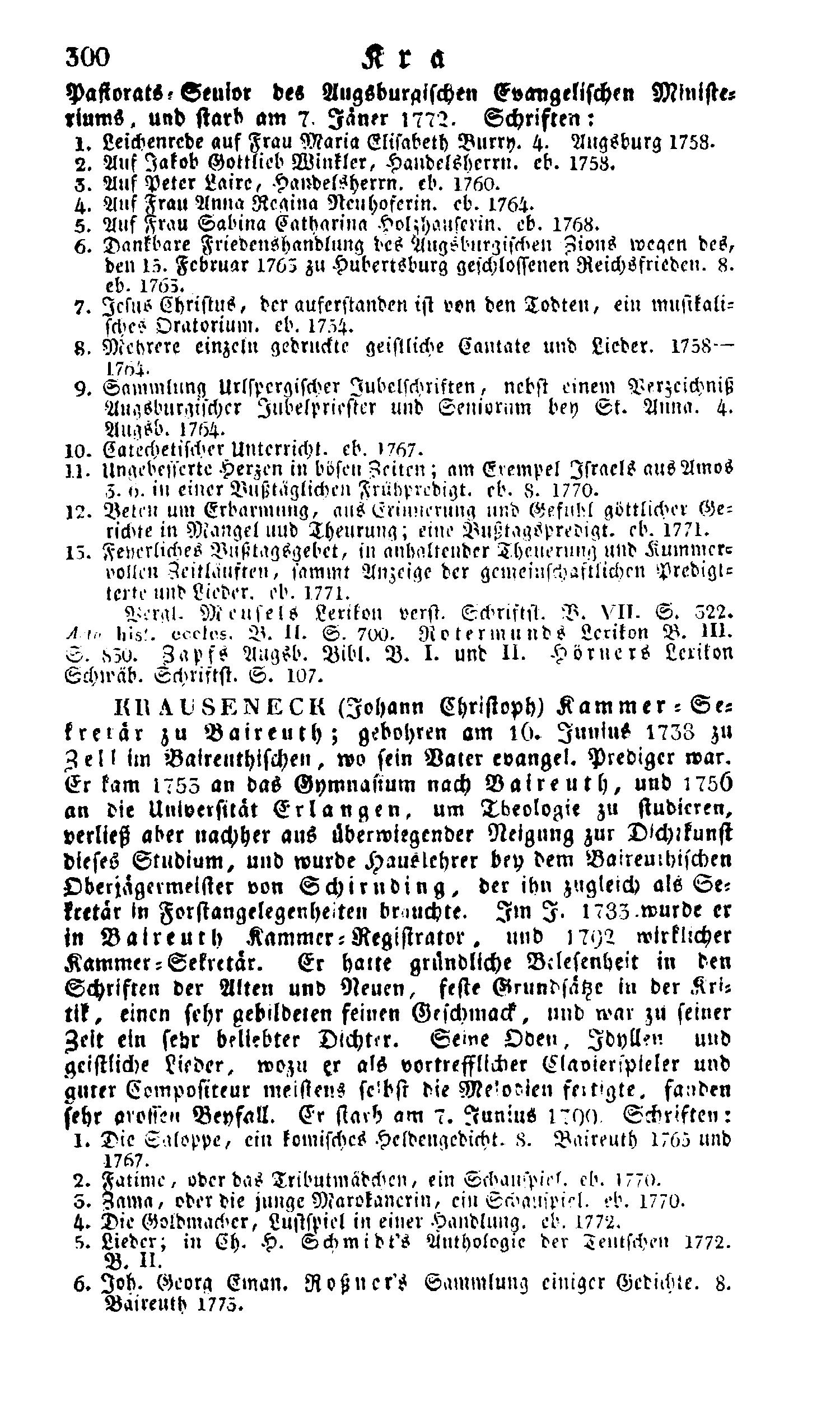
Footnotes
- ↑ See General Teutsche Bibl. B. 31. II. p. 497.
- ↑ s. Gotth. gel. Z. 1776. St. 47. S. 377.
- ↑ See Teutscher Merkur, 1777, Sept., p. 286.
- ↑ See Obert. Lit. Z. 1790. I. p. 670. Allg. teutsche Bibl. B. 111. I. S. 108.


 Previous
post

 Next
post